
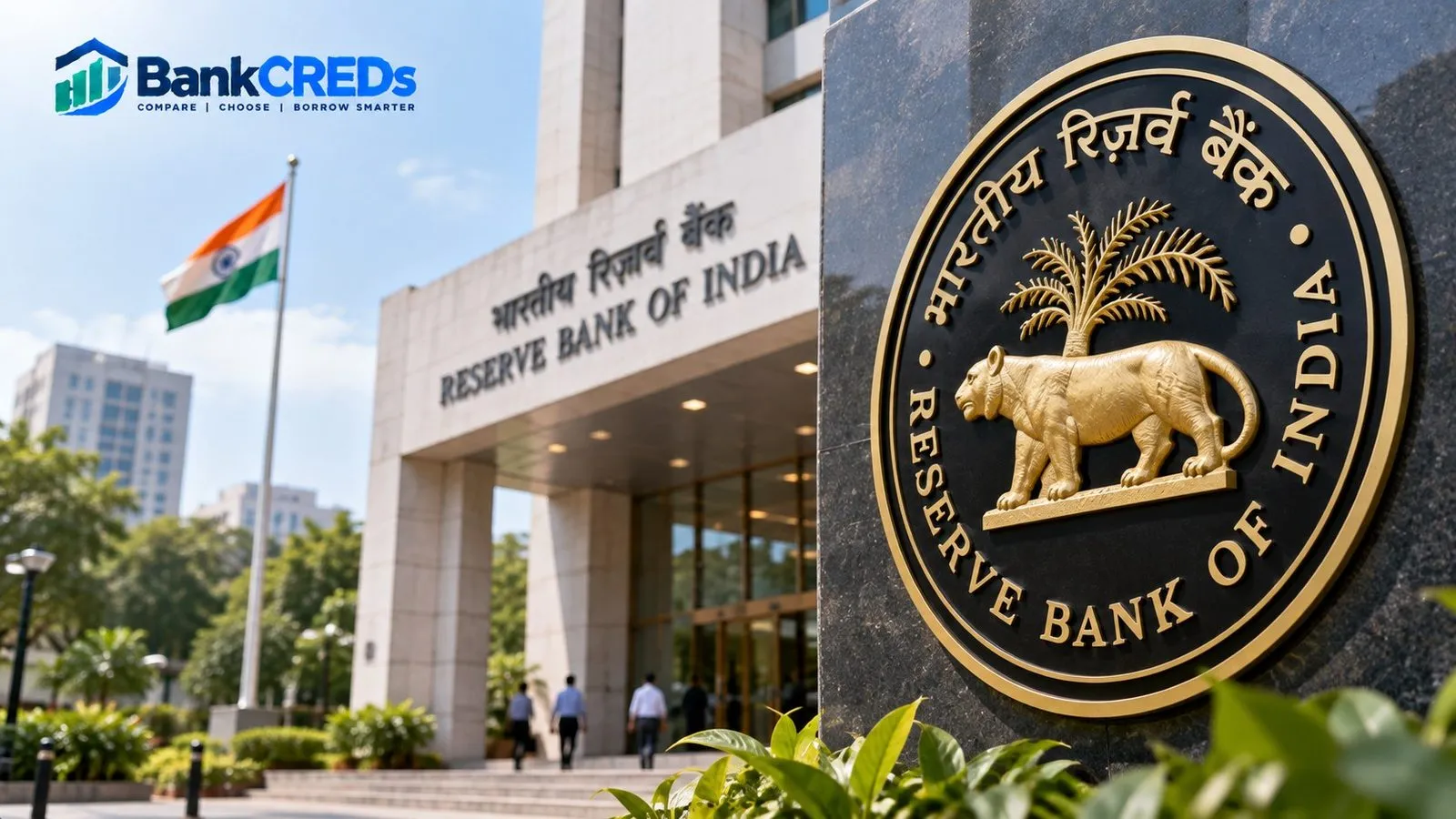
According to reporting by Business Today, a 25 basis point increase in the RBI repo rate could add about ₹2.45 lakh to the interest paid on a home loan over 25 years. For borrowers with a floating-rate loan linked to the repo rate, that would show up as a slightly higher EMI, or a longer repayment period, once the lender passes the change on.
The figure is a calculation of how sensitive a long loan is to a small rate change, not a guarantee of what any one borrower will pay. The real number depends on your loan size, your current rate, how much tenure is left and whether you prepay.
Below we explain how a repo rate change reaches your loan, show our own worked arithmetic on three loan sizes, and set out what to do now. The ₹2.45 lakh figure is as reported by Business Today. The examples that follow are BankCreds' own illustrations from standard EMI formulas.
Key takeaways
- A 25 bps change is 0.25 percentage points. On a long loan it compounds into a lakh-rupee difference, even though the monthly effect looks small.
- Only floating-rate loans linked to an external benchmark such as the repo rate respond quickly. Fixed-rate loans do not change until they are refinanced.
- On our illustrative ₹50 lakh, 25-year loan at 8.5 percent, a 0.25 point rise adds roughly ₹845 to the EMI and about ₹2.5 lakh in total interest.
- Lenders usually offer a choice between a higher EMI and a longer tenure. Keeping the EMI unchanged can extend a 25-year loan by about two years.
- Part-prepayments in the early years are the most effective counter, and floating-rate loans to individuals carry no prepayment charge under RBI rules.
How a repo rate change reaches your home loan
The repo rate is the rate at which the Reserve Bank of India lends short-term money to banks. When it rises, banks' cost of funds tends to rise, and lenders adjust the rates they charge. For home loans, the link is most direct for loans benchmarked to an external benchmark. Since the 2019 rules, most new floating-rate retail loans are priced as a benchmark, commonly the repo rate, plus a spread that the lender sets and can change only in limited circumstances.
The pass-through is mechanical. If your loan is priced at repo plus a spread, a 0.25 point rise in the repo rate lifts your interest rate by 0.25 points, typically at the next reset date. Resets happen at intervals set in your loan agreement, and the benchmark must be reviewed at least once every quarter.
Older loans tied to a lender's MCLR or the base rate respond more slowly and less completely. If you are unsure which category you are in, your sanction letter and the latest statement of account will say so. Many such borrowers can switch to the benchmark-linked structure, though lenders may charge a switching fee.
If you are comparing where rates sit across lenders, the interest rate tables are a good starting point. For general guidance on loan structure, see our home loan guides.
The arithmetic: what 25 bps does to a 25-year loan
The reported ₹2.45 lakh figure depends on assumptions we do not have: the loan amount and the starting rate. To see the mechanism, we ran our own numbers using the standard EMI formula, a 25-year (300-month) tenure, and a rise from 8.5 percent to 8.75 percent. These are illustrations, not market quotes.
| Loan amount | EMI at 8.50% | EMI at 8.75% | Monthly increase | Extra interest over 25 years |
|---|---|---|---|---|
| ₹25 lakh | about ₹20,130 | about ₹20,550 | about ₹420 | about ₹1.3 lakh |
| ₹50 lakh | about ₹40,260 | about ₹41,110 | about ₹845 | about ₹2.5 lakh |
| ₹75 lakh | about ₹60,390 | about ₹61,660 | about ₹1,270 | about ₹3.8 lakh |
The pattern is straightforward. The extra cost scales almost in proportion to the loan size, and the monthly increase is small relative to the EMI, around 2 percent. The lifetime figure feels large because it multiplies a modest monthly amount by 300 payments.
It also assumes the higher rate applies for the entire 25 years. In practice, rates have moved up and down over any such period, and a borrower who prepays or whose rate later falls will pay less than the table suggests.
You can test your own numbers with the EMI calculators, entering your outstanding balance, remaining tenure and the new rate.
EMI up or tenure longer: your choice
When the rate on a floating-rate loan changes, RBI's framework for lenders requires them to give the borrower clarity on the impact. Borrowers are generally offered the option to increase the EMI, extend the tenure, or a combination of the two, and lenders must communicate the change through a statement and keep the borrower informed.
Many lenders default to extending tenure because it leaves the EMI unchanged. That feels painless but has a hidden cost. On our illustrative ₹50 lakh loan, keeping the EMI at about ₹40,260 after the rise to 8.75 percent would extend repayment from 300 months to roughly 325 months, a little over two extra years. You would pay interest for those extra months, which is why the lifetime cost grows even though your monthly outgo does not.
The trade-off is therefore between cash flow today and total cost. If your budget can absorb the higher EMI, taking it keeps the end date intact. If you are stretched, extending the tenure is a legitimate short-term choice, and you can shorten it later by prepaying.
Who is affected and who is not
Not every borrower feels this equally. A quick way to sort yourself:
- Floating-rate, benchmark-linked loan: directly affected, with the change applied at the next reset.
- MCLR or base-rate linked loan: affected, but more slowly, and the effect depends on the lender's own cost of funds.
- Fixed-rate loan: not affected until the fixed period ends or you refinance. Some home loans are fixed for an initial period and then become floating.
- Very early in a long loan: most affected in rupee terms, because interest dominates the early EMIs.
- Close to the end of the loan: barely affected, since the outstanding balance and the remaining months are small.
- Prospective buyers: a higher rate reduces the loan an income can support, so a borrower sanctioned a given EMI will qualify for a slightly smaller amount.
If you are planning a purchase, the eligibility check can show how a higher rate affects the amount you can borrow.
What to do now: a practical checklist
There is no need to act in haste, but a few steps are worth doing this month:
- Identify your benchmark. Check your sanction letter for whether the loan is repo-linked, MCLR-linked or fixed.
- Note your spread and reset date. The spread is what your lender adds to the benchmark, and the reset date tells you when a change will take effect.
- Choose EMI or tenure deliberately. Do not let the lender decide by default. Ask for the revised repayment schedule in writing.
- Run a prepayment scenario. Even a modest lump sum in the early years cuts the interest on the remaining balance.
- Compare your spread with new-customer offers. If your lender's spread is well above what new borrowers are quoted, ask for a reduction, and consider a balance transfer only after costing the fees.
- Keep an emergency buffer. Six months of EMIs and expenses protects you from a squeeze if rates move further.
Common mistakes to avoid
The most common error is to ignore a tenure extension because the EMI did not change. Over a few resets, a loan meant to end in 25 years can quietly run to 30 or more.
The second is switching lenders for a small rate gap. Processing fees, legal charges and the reset of the early-interest-heavy schedule can cancel a 0.25 point saving. Do the arithmetic on the full cost before moving.
The third is treating the lifetime interest figure as a bill due now. The ₹2.45 lakh figure, like our table, is spread over 300 months and assumes the higher rate never falls. It is a measure of sensitivity, and should be read that way.
Finally, borrowers sometimes prepay from money that should have stayed as an emergency fund. Prepaying saves interest, but liquidity matters more than a quarter-point.
Outlook: how much should one rate move matter
A single 25 bps move is within the normal range of RBI policy changes, and over a long loan it is one of many. Home loan rates also depend on the lender's spread, your credit profile and the competitive market, and RBI's policy rate is only one input.
The lasting point from the Business Today calculation is that small rate differences matter on long loans, and that the borrower has real levers: choosing EMI over tenure, prepaying early, and negotiating the spread. For the latest developments on rates and lending, follow our news hub.
Frequently asked questions
Will a 25 bps repo rate hike raise my home loan EMI?
If your loan is floating-rate and linked to the repo rate, your interest rate will rise by the same 0.25 points at the next reset. Your lender may then raise the EMI or extend the tenure. Fixed-rate loans do not change until the fixed period ends.
How much extra interest does a 0.25 percent rise add?
It depends on the loan size, tenure and starting rate. On our illustration of ₹50 lakh over 25 years, the rise from 8.5 to 8.75 percent adds about ₹2.5 lakh in total interest. Business Today's calculation reported a figure of about ₹2.45 lakh for its own assumptions.
Should I choose a higher EMI or a longer tenure?
If you can afford it, a higher EMI keeps your end date and lowers total interest. A longer tenure keeps the monthly payment steady but, on our example, adds around two years of interest. You can also start with a longer tenure and shorten it later through prepayment.
Do I pay a penalty for prepaying a floating-rate home loan?
Under RBI rules, lenders cannot charge prepayment penalties on floating-rate loans to individual borrowers. Check your loan agreement, because fixed-rate loans may carry charges. A part-prepayment is usually the simplest way to offset a rate rise.
Should I switch to another lender after a rate rise?
Only if the saving exceeds the costs. Compare the spread, processing fee and legal charges, and ask your current lender to match the offer first. A gap of a quarter-point rarely justifies a switch on its own.
BankCreds analysis
The ₹2.45 lakh figure sounds large, but it is spread over 25 years and over a loan of unknown size, so it is worth translating into monthly terms. On our own illustrative loan of ₹50 lakh at 25 years, a 0.25 percentage point rise adds roughly ₹845 to the monthly EMI. That is about 2 percent of a typical EMI of ₹40,000. For a household earning ₹1.2 lakh a month, it is a tightening, not a crisis.
The borrowers who should pay closest attention are those at the start of a long loan. Interest is front-loaded, so the rate matters most in the first decade. A buyer who took a loan this year with a thin margin between EMI and income, and who is also carrying a car loan or credit card balance, has the least room. Someone ten years into a loan with a small balance barely notices.
What this does not mean
The headline is a calculation, not a forecast. It shows the sensitivity of a loan to 25 bps; it does not tell you the rate will rise, or that it will stay up for 25 years. Rates move in both directions across a loan's life, and the lifetime figure assumes the higher rate is permanent. Also, many borrowers will see the effect as a longer tenure rather than a bigger EMI, which hides the cost but does not remove it. On the illustration above, the same EMI would stretch the loan by about two years.
This week, the useful action is not to panic-refinance. Log in to your lender's portal, check your current rate, spread and remaining tenure, and run a prepayment scenario. A single part-prepayment of a bonus or tax refund often offsets a quarter-point rise by itself, and costs nothing on a floating-rate loan to an individual.
This section is BankCreds' own assessment of what the development means for Indian borrowers and savers. It is independent commentary, not part of the source reporting above.
Sources & references
- Business Today — originating report https://www.businesstoday.in/personal-finance/story/25-bps-rbi-repo-rate-hike-could-add-rs2-45-lakh-to-home-loan-interest-over-25-years-heres-the-calculation-559689-2026-10-06
- Reserve Bank of India — repo rate is set by RBI's monetary policy https://www.rbi.org.in/
- RBI Master Directions — rules on floating-rate resets, EMI or tenure choice and prepayment charges https://www.rbi.org.in/Scripts/BS_ViewMasDirections.aspx
Source links are shown as plain text, not clickable links. Copy a URL into your browser to read the original report.
Editorial note & disclaimer
How this was reported. The development above is attributed to the source or sources listed. BankCreds does not independently verify a third party's reporting; where a figure or a regulatory position is stated as fact, it is either attributed or drawn from the regulator's own published material. Everything under "BankCreds analysis" is our own assessment.
Rates and figures. Interest rates, per-gram values and premium bands quoted here are indicative, move daily, and differ by borrower profile, city and lender policy. Confirm the final number with the institution before you act on it — the sanction letter or policy schedule governs, not a news report.
Not financial advice. This article is general information for an Indian audience. It is not investment, tax, credit or insurance advice, takes no account of your circumstances, and BankCreds is not a lender, broker, distributor or advisor. Consider speaking to a SEBI-registered investment adviser or a qualified professional before acting.
Editorial policy · Fact-checking policy · Corrections policy · Our authors · About BankCreds · Contact us
Spotted an error? Corrections are published, not quietly edited — write to us via the contact page and see our corrections policy.