
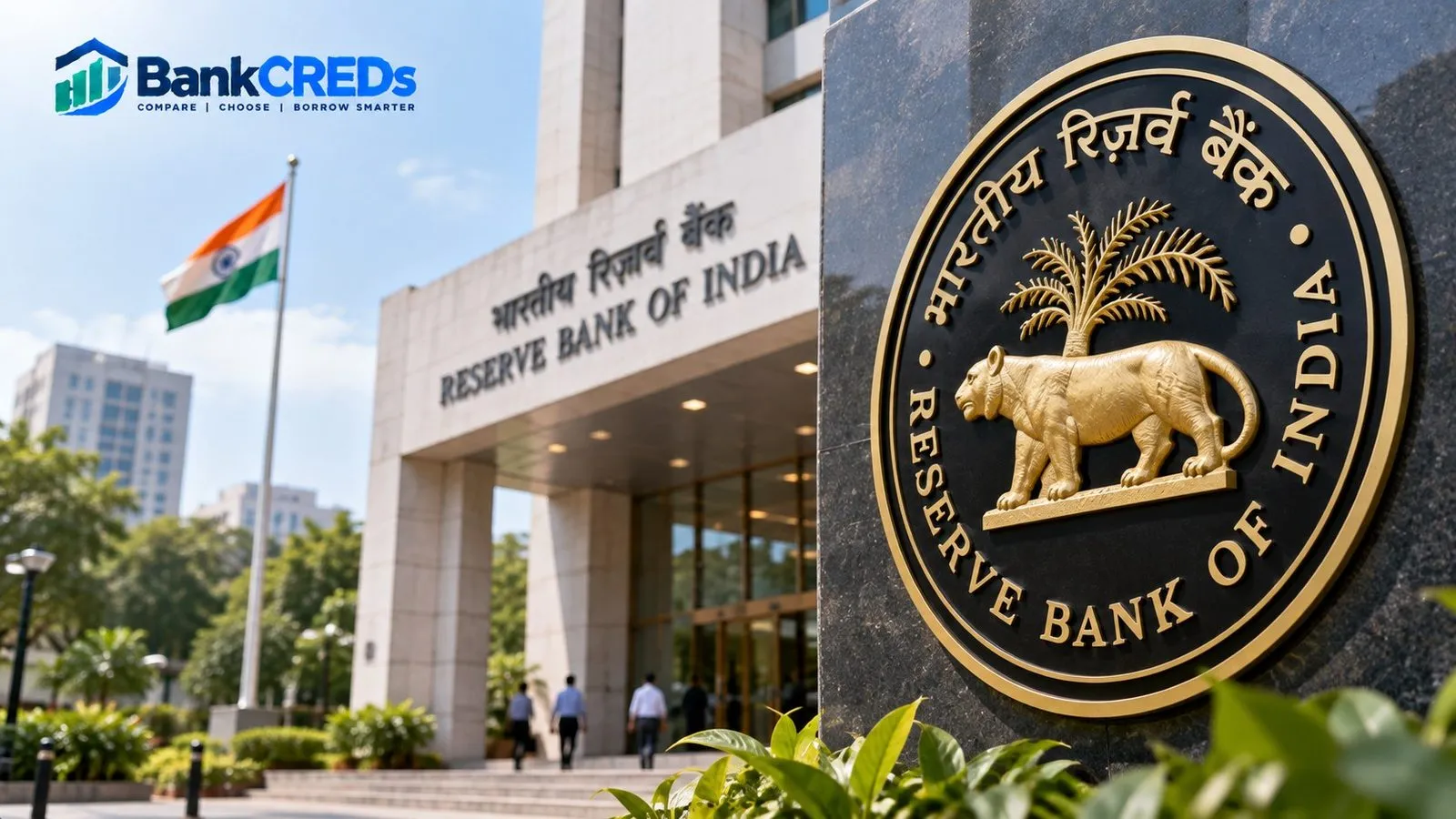
Nifty and Sensex rallied about 3.5% in a single session as a US-Iran ceasefire lifted market sentiment, according to reporting by Goodreturns. Investors are now waiting for the outcome of the RBI Monetary Policy Committee (MPC) meeting.
For borrowers and savers, the rally does not change your EMI or your fixed deposit rate today. What matters is what the RBI decides. The ceasefire mainly eases worries about oil, the rupee and inflation, which are the very things the MPC weighs.
This article explains how that chain works, what a rate decision would mean in rupees for a typical loan, and what to do while the outcome is pending. We only know the headline development as reported, so we do not put numbers on the policy outcome. We show how any change would work instead.
Key takeaways
- Nifty and Sensex jumped about 3.5% on the US-Iran ceasefire, as reported by Goodreturns, with the RBI MPC outcome the next big event.
- A stock market rally does not change your loan EMI or deposit rate. Only the RBI's repo rate decision and your lender's or bank's response can do that.
- A quarter-point change in a home loan rate moves the EMI on a ₹50 lakh, 20-year loan by roughly ₹790 a month.
- Floating-rate borrowers gain or lose first when the repo rate changes. Fixed-rate borrowers are unaffected until they refinance.
- Savers should compare deposit rates before the decision if a renewal is due, because a rate cut tends to lower new deposit rates.
- Do not make big financial decisions on a one-day market move. Plan around what you can control.
What happened in the market and why it matters
According to the report, Indian equity benchmarks rose sharply because a ceasefire between the United States and Iran improved the mood of investors. A jump of this size in one session is unusual and shows how much of the earlier caution came from geopolitical risk rather than from domestic business conditions.
Why would a conflict far from India move Indian share prices? India imports most of its crude oil, so tension in West Asia tends to push up energy prices, weaken the rupee and raise the cost of doing business. When a ceasefire reduces that risk, investors mark down those fears at once, and share prices adjust quickly.
For an ordinary household, the useful reading is this. The rally is a change in sentiment. It is not a change in your salary, your loan agreement or your deposit rate. The indirect link, through oil, the rupee and inflation, is real but slow, and it passes through the RBI before it reaches you.
How the RBI MPC decision reaches your loan EMI
The MPC is the committee that decides the policy repo rate, the rate at which the RBI lends short-term money to banks. Since October 2019, banks have had to link new floating-rate retail loans, such as home loans, to an external benchmark, and most use the repo rate. When the repo rate changes, the lending rate on these loans changes after the lender's reset date, usually within a few months and sometimes sooner.
There are three broad situations, and it helps to know which one applies to you.
- Repo-linked floating-rate loan: Your rate moves with the repo rate, plus a fixed spread set by your lender. A cut lowers your rate. A hike raises it.
- Older MCLR-linked loan: Your rate changes only at each reset date, so any pass-through is delayed and can be smaller.
- Fixed-rate loan: Your rate does not change during the fixed period, whatever the RBI does. Personal loans and many instant loans are commonly fixed.
On a floating loan, lenders usually keep your EMI unchanged and change the tenure instead, unless you ask otherwise. That is why a rate change can quietly add or remove months from your loan. It is worth checking your loan statement after any change.
Worked example: what a rate change does to a home loan EMI
Let us take a ₹50 lakh home loan over 20 years and see how the EMI changes with the interest rate. These are illustrative rates, not a forecast of the RBI decision or of any lender's pricing.
| Interest rate | Monthly EMI (approx.) | Change vs 8.50% | Total interest over 20 years (approx.) |
|---|---|---|---|
| 8.75% | ₹44,190 | +₹800 | ₹56.1 lakh |
| 8.50% | ₹43,390 | Base | ₹54.1 lakh |
| 8.25% | ₹42,600 | -₹790 | ₹52.2 lakh |
| 8.00% | ₹41,820 | -₹1,570 | ₹50.4 lakh |
A quarter-point cut saves around ₹790 a month. Over the full 20 years, if the rate stayed lower and you kept paying the same EMI amount, you would pay far less interest, and the loan would end earlier. A half-point cut nearly doubles the monthly saving.
You can run the numbers for your own loan with our EMI calculator, and our home loan guides explain how resets and tenure changes work.
Why a ceasefire matters for inflation, oil and the rupee
The MPC's main job is to keep retail inflation near its target while supporting growth. Three channels connect a ceasefire to that job.
First, oil. If tension eases and crude prices soften, fuel and transport costs tend to ease, which reduces pressure on inflation. Second, the rupee. A calmer global mood can reduce outflows from Indian markets and support the currency, and a steadier rupee makes imports cheaper. Third, confidence. Businesses and households spend and invest more when uncertainty falls.
We do not know how the MPC will weigh these factors, and neither does the market until the announcement. A ceasefire can make the committee more comfortable, but it does not obligate it to change rates. The decision also depends on domestic food prices, growth data and global interest rates, none of which the headline tells us. The RBI itself is the authority on the outcome, and its statements are published at rbi.org.in.
What savers and fixed deposit holders should do
Deposit rates generally follow the direction of policy rates with a lag. If the MPC cuts rates, banks tend to lower new fixed deposit rates within weeks. If it holds, deposit rates usually stay near current levels. Existing deposits are not affected, because their rate is locked in at booking.
Here is what the difference looks like. On a ₹10 lakh deposit, a rate of 7% earns about ₹70,000 in a year, while 6.75% earns about ₹67,500. That is a gap of roughly ₹2,500 a year, which is small but real. Compare current offers on our interest rates page.
A sensible approach for savers:
- If a deposit matures within a few weeks, compare rates now and consider booking before the announcement, because rates are more likely to go down than up after a supportive event.
- Keep deposits within insured limits. DICGC insurance covers up to ₹5 lakh per depositor per bank, and you can check the rules at dicgc.org.in.
- Ladder your deposits across different maturities so you are not forced to renew everything at one rate.
- Do not lock in a very long tenure only because rates look high today, unless you are sure you will not need the money.
What to do this week
The most useful things to do are boring and specific. This checklist works whichever way the MPC decides.
- Check what type of loan you have. Look at your sanction letter for the words repo-linked, EBLR, MCLR or fixed.
- Note your reset date. If your rate resets soon, a policy change is more likely to reach you sooner.
- Know your current rate and spread. If you pay a much higher rate than new borrowers at the same lender, ask about a rate reduction or a switch.
- Check your credit score before applying. A better score can get you a better rate, and you can test your position with our eligibility check.
- Keep your emergency fund out of the market. Market rallies are not a reason to move money you may need within a year into equities.
- Read the RBI statement on the day. Wait for the actual outcome and lender announcements before changing anything.
For updates on how the decision is reported, you can follow our news hub.
Common mistakes to avoid after a market jump
A sharp one-day rally can push people into decisions they later regret. These are the mistakes we see most often.
Treating a rate cut as certain. The headline says attention is on the outcome, which means the outcome is not yet known. Do not prepay, refinance or delay a deposit on the assumption that a cut is coming.
Chasing the rally. Moving savings into equities after a 3.5% jump means buying after the price has already risen. If you invest through SIPs, keep them steady rather than raising them because of one good day.
Expecting an instant EMI cut. Even if the RBI cuts the repo rate, your lender decides when and how the change reaches you. Check your reset date and ask your lender in writing if you are unsure.
Ignoring fixed-rate loans. Borrowers with fixed-rate personal or instant loans will not see any change, so compare the cost of your loan with new offers on our personal loan page before assuming you are stuck.
Confusing a loan's rate with its total cost. Processing fees, prepayment charges and insurance add to the cost. Compare the full cost, not only the headline rate.
Frequently asked questions
Will the Nifty and Sensex rally lower my home loan EMI?
No. Your EMI depends on your loan's interest rate, which follows the RBI repo rate for floating loans, not on share prices. The rally can influence the MPC's comfort with easing indirectly, but only the MPC's decision and your lender's pass-through change your EMI.
What is the RBI MPC and why does its outcome matter?
The Monetary Policy Committee is the RBI body that decides the policy repo rate. Because floating-rate loans and new deposit rates follow that rate, its decision affects what borrowers pay and what savers earn, usually within weeks or months.
Should I book a fixed deposit before the RBI announcement?
If a deposit is maturing soon, comparing and booking before the announcement is reasonable, since a rate cut tends to lower new deposit rates. But the outcome is not known, so do not rush a decision you were not already planning to make.
Does a US-Iran ceasefire affect gold prices?
Gold often reacts to geopolitical tension, and a ceasefire can reduce safe-haven demand. We do not have specific price information from the source, so check the current gold rate today instead of assuming a direction.
How much can a rate cut save on a loan?
On a ₹50 lakh, 20-year home loan, a quarter-point cut lowers the EMI by roughly ₹790 a month. The saving scales with the loan size and the size of the cut, so use an EMI calculator with your own numbers.
BankCreds analysis
The 3.5% jump is a big number for a single session, but it is a number for people who already own equities. For a household with ₹5 lakh in equity funds it is roughly ₹17,500 on paper, and paper gains after a relief rally can reverse just as fast if the ceasefire wobbles. It is not income, and it should not change your budget.
The number that can change a budget is the RBI decision. Take a ₹50 lakh, 20-year floating-rate home loan at 8.5%. A quarter-point cut lowers the EMI from about ₹43,400 to about ₹42,600, a saving near ₹790 a month, or roughly ₹9,500 a year. That is about half of the paper gain above, but it recurs every year and is contractual, provided your lender passes the cut on. So for a salaried borrower, the policy outcome matters more than the index move.
What the rally does not mean
It does not mean a rate cut is coming. The headline says all eyes are on the outcome, which means it was undecided when the report was written. A ceasefire can ease oil and currency worries, but the MPC also weighs inflation trends, growth and global rates. Markets can rally on relief without any policy change following.
It also does not mean fixed deposit rates are about to jump. If anything, calmer conditions make a rate cut slightly easier to justify, and that would push new deposit rates down rather than up. A saver who has been waiting for a better rate should not read a stock rally as a signal to wait longer.
What to do differently this week
Borrowers: do nothing rash, and check whether your loan is linked to the repo rate so you know how quickly a change would reach you. Savers: if a deposit is due for renewal soon, compare rates now rather than after the announcement. Investors: a one-day jump is a poor reason to raise your SIP or to sell. Decide on the allocation you planned, not on the headline.
This section is BankCreds' own assessment of what the development means for Indian borrowers and savers. It is independent commentary, not part of the source reporting above.
Sources & references
- Goodreturns — originating report https://www.goodreturns.in/news/stock-market-today-nifty-sensex-jump-3-5-as-us-iran-ceasefire-lifts-sentiment-all-eyes-on-rbi-mp-1500997.html
- Reserve Bank of India — RBI's Monetary Policy Committee sets the repo rate that drives floating-rate loans https://www.rbi.org.in/
- DICGC deposit insurance — Bank deposits are insured up to ₹5 lakh per depositor per bank https://www.dicgc.org.in/
Source links are shown as plain text, not clickable links. Copy a URL into your browser to read the original report.
Editorial note & disclaimer
How this was reported. The development above is attributed to the source or sources listed. BankCreds does not independently verify a third party's reporting; where a figure or a regulatory position is stated as fact, it is either attributed or drawn from the regulator's own published material. Everything under "BankCreds analysis" is our own assessment.
Rates and figures. Interest rates, per-gram values and premium bands quoted here are indicative, move daily, and differ by borrower profile, city and lender policy. Confirm the final number with the institution before you act on it — the sanction letter or policy schedule governs, not a news report.
Not financial advice. This article is general information for an Indian audience. It is not investment, tax, credit or insurance advice, takes no account of your circumstances, and BankCreds is not a lender, broker, distributor or advisor. Consider speaking to a SEBI-registered investment adviser or a qualified professional before acting.
Editorial policy · Fact-checking policy · Corrections policy · Our authors · About BankCreds · Contact us
Spotted an error? Corrections are published, not quietly edited — write to us via the contact page and see our corrections policy.