
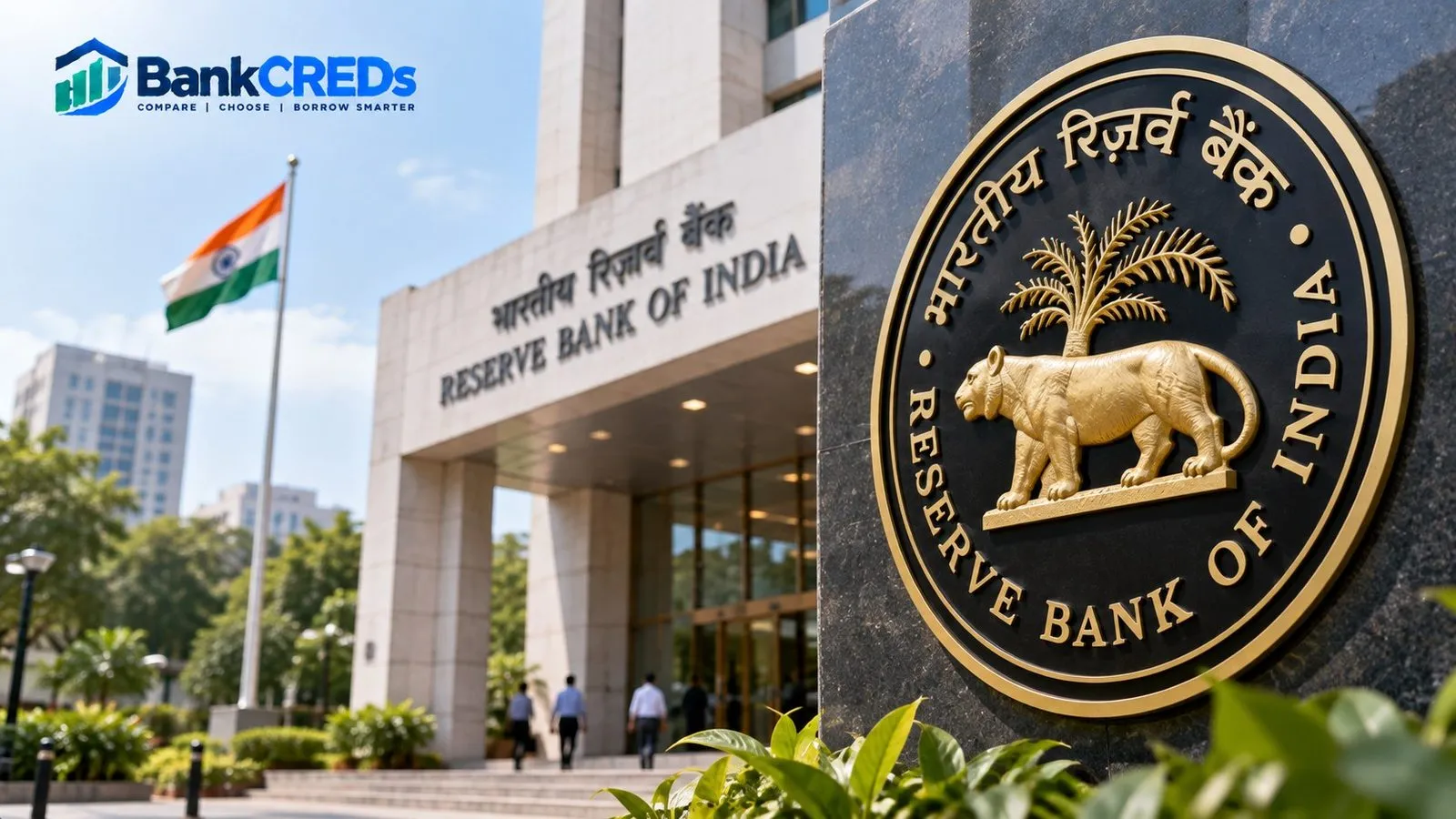
News9live reports that the Reserve Bank of India's Monetary Policy Committee (MPC) meeting has reached the point where its decision is about to be announced, and the question on borrowers' minds is whether EMIs on car loans and home loans will go up. At the time of writing, the outcome had not been confirmed in the reporting we are working from, so this article explains what each possible result means for your instalment.
The short answer: if you hold a floating-rate home loan linked to the repo rate, your EMI or loan tenure can change only if the MPC changes the repo rate, and even then only when your loan next resets. If you hold a fixed-rate car loan, a policy decision does not change your EMI at all.
Below, we walk through how the repo rate reaches your loan, show the arithmetic on realistic loan sizes, and list what to check this week.
Key takeaways
- The RBI's MPC decides the repo rate, the benchmark that most floating-rate home loans in India are now linked to. A decision is reported to be imminent, according to News9live.
- A rate change does not hit your EMI the same day. It flows through your lender's reset date, which is commonly every three months for repo-linked loans.
- Car loans are mostly fixed-rate, so existing car loan EMIs generally stay the same whatever the MPC decides. New car loan quotes are what shift.
- As an illustration, a 0.25 percentage point change alters the EMI on a ₹50 lakh, 20-year home loan by about ₹790 a month.
- On a rate rise, lenders often extend your tenure rather than raise the EMI, which quietly increases total interest. Ask which one your lender has chosen.
How the RBI repo rate reaches your EMI
The repo rate is the rate at which the RBI lends short-term money to banks. When the MPC raises it, banks' funding gets costlier and they tend to pass this on; when it cuts, funding gets cheaper and lending rates tend to ease. The MPC meets on a scheduled calendar through the year and announces its decision at the end of each meeting.
Since the RBI moved banks to external benchmark-linked lending, floating-rate retail loans, including home loans, are priced as a benchmark plus a spread. For most banks the benchmark is the repo rate. The spread is the lender's own margin for credit risk and operating costs, and it is fixed in your loan agreement unless the lender changes it. Your rate is therefore repo plus spread, and a change in the repo rate moves your rate by the same amount, usually at the next reset date set in your sanction letter.
This is why the headline question is only half-answered by the MPC outcome. The other half is your own loan's structure: what benchmark it uses, when it resets, and whether your lender adjusts EMI or tenure.
Home loan EMI: what a rate change looks like in rupees
Home loan borrowers are the group most directly exposed, because the loans are large and long. The table below shows illustrative EMIs for a ₹50 lakh loan over 20 years at different interest rates. These are arithmetic examples using the standard EMI formula, not forecasts of what your lender will charge.
| Interest rate (p.a.) | Monthly EMI on ₹50 lakh, 20 years | Difference from 8.50% |
|---|---|---|
| 8.25% | about ₹42,600 | about ₹790 lower |
| 8.50% | about ₹43,390 | baseline |
| 8.75% | about ₹44,190 | about ₹800 higher |
| 9.00% | about ₹44,990 | about ₹1,600 higher |
A quarter-point move is therefore under ₹800 a month on a loan of this size. Over a year, that is about ₹9,500, which matters but will not break a household budget. If you want to test your own numbers, our EMI calculator lets you change the rate, amount and tenure, and our home loan guides explain how banks structure resets.
Car loan EMI: why the headline overstates the risk
Most car loans in India carry a fixed interest rate for the full term. If you already have one, your EMI was locked when you signed, and a repo rate decision does not alter it. The effect shows up only for people who are about to take a new loan, where the lender's offer may be repriced after the policy decision.
Here is a worked example for a ₹8 lakh car loan over five years:
| Rate (p.a.) | Monthly EMI | Total interest over 5 years |
|---|---|---|
| 9.00% | about ₹16,610 | about ₹1.96 lakh |
| 9.25% | about ₹16,685 | about ₹2.01 lakh |
| 10.00% | about ₹17,000 | about ₹2.20 lakh |
A quarter-point change on this loan is under ₹80 a month. Your negotiated rate, your credit score and the processing fee will usually move the cost of the loan more than a policy decision will. For a view of how lenders price different products, see our interest rate tables.
Who is affected and who is not
Not every borrower reacts to an MPC decision in the same way. Here is a quick way to sort yourself:
- Floating-rate home loan linked to the repo rate: directly affected, at your next reset.
- Home loan on an older MCLR or base-rate structure: affected more slowly and less predictably, since these reset on the lender's own schedule.
- Fixed-rate car loan or personal loan: not affected for the existing loan. Only new quotes change.
- Fixed deposit holders and savers: deposit rates tend to follow policy rates with a lag, so a cut can mean lower rates on new or renewed deposits, while a rise can mean better ones.
- Prospective borrowers: affected through the rate on offer, but also by your credit score, income and the lender's own spread.
If you are planning a personal borrowing decision, our personal loan guides cover how pricing differs from secured loans.
EMI or tenure: the quiet change most borrowers miss
When rates rise on a floating loan, lenders have two options. They can raise your EMI, or they can keep the EMI the same and stretch the tenure. Many banks default to the second, because it avoids a visible jump in your monthly outgo. The cost is hidden: a longer tenure means you pay interest for more months.
As a rough illustration, on a ₹50 lakh loan with about 15 years remaining, a half-point rise with the EMI held constant can add several months to the term, and each added month carries a full instalment of interest-heavy payments. If you did not choose this, you may not notice it until you read your next statement.
The reverse also applies. After a cut, a lender that shortens your tenure instead of lowering your EMI is quietly saving you interest, which can be better than a smaller instalment if your budget allows the same payment.
What to do now: a practical checklist
You do not need to act before the outcome is clear. These steps are sensible whichever way the MPC goes:
- Find your loan's benchmark and reset date in the sanction letter or your lender's app. This tells you when any change will actually reach you.
- Check whether your lender adjusts EMI or tenure after a rate change, and ask to switch to the option that suits you.
- Compare your spread with today's new-customer offer. If you are paying a noticeably higher spread than a new borrower would, ask for a spread reduction first.
- Run the numbers on our EMI calculator for a 0.25 and 0.50 point change so you know your exposure in advance.
- Keep a buffer. Having three to six months of EMIs in an accessible account lets you absorb a rise without selling investments in a hurry.
- Consider small part-prepayments if you have surplus cash. On floating-rate home loans, part-prepayment typically carries no penalty for individual borrowers, and it cuts interest faster than waiting for a rate cut.
Common mistakes borrowers make around policy day
A few errors come up repeatedly when headlines like this one circulate:
- Assuming the EMI changes immediately. Resets follow your loan's schedule, not the announcement date.
- Rushing into a balance transfer over a small rate gap. Processing fees, legal charges and the loss of accumulated tenure benefit can cancel a saving of a few hundred rupees a month.
- Ignoring the credit score. A better score can win a lower spread, which beats waiting for a policy cut.
- Treating one meeting as the whole trend. Rate cycles unfold over many meetings, and a single decision does not settle where your loan costs are headed.
- Forgetting savings. If you hold fixed deposits, a rate decision matters for you too, though deposit rates adjust more slowly than loan rates.
Outlook: watch the pattern, not the day
Policy rates in India have moved in multi-meeting cycles, with long pauses in between. The more useful question than whether today's decision raises your EMI is whether you can comfortably afford your loan across a range of rates. A household that can absorb a one-point rise is far less exposed to headlines than one that cannot. For continuing updates, follow our news hub, where we will track the MPC outcome and its effect on lending rates as reporting becomes available.
Frequently asked questions
Will my car loan EMI go up after the RBI MPC decision?
If your car loan has a fixed interest rate, which is the usual structure, your existing EMI will not change whatever the MPC decides. Only new car loan quotes may be repriced by lenders after the announcement.
When will a repo rate change show up in my home loan EMI?
It reaches you at your loan's next reset date, which for many repo-linked loans is every three months, as stated in your sanction letter. Your lender may also choose to adjust your tenure rather than your EMI.
How much does a 0.25% rate change affect a home loan?
On a ₹50 lakh loan over 20 years, a quarter-point change moves the EMI by roughly ₹790 a month, using the standard EMI formula. The impact scales with your loan amount and remaining tenure.
Should I switch lenders if rates change?
Not automatically. First ask your current lender to reduce your spread, and compare the full cost of a switch, including fees, against the monthly saving. A small rate gap often does not justify a balance transfer.
Does the repo rate affect fixed deposits too?
Yes, with a lag. Banks generally revise deposit rates after policy rate changes, so new or renewing deposits may carry different rates, while existing deposits stay at the rate you locked in.
BankCreds analysis
The headline frames the MPC meeting as a binary event for your EMI, but for most borrowers the decision matters far less than the framing implies. A 25 basis point move changes the EMI on a ₹50 lakh, 20-year home loan by roughly ₹790 a month, which is about 1.8% of the instalment. That is real money over years, but it is not a shock that should trigger a panic refinance or a rushed prepayment.
Who is actually exposed
The people who feel a policy move first are borrowers on repo-linked floating loans, which is nearly every home loan taken in recent years. Someone with a fixed-rate car loan, which is the usual structure, will see no change at all, so the headline's pairing of car and home loans is misleading for that group. Car loan EMIs are really set when you sign, and a repo move only affects the next quote you get.
The second group that gains or loses is the prospective borrower. If you are about to sign a loan, a cut or hike changes the rate you are offered within weeks, but lenders also reprice on their own spreads, credit-score bands and competitive pressure. Your credit score can move your quoted rate by more than a quarter-point policy change can.
What to do differently this week
Nothing dramatic. Check whether your loan is repo-linked and what your reset date is, because the change reaches you only at reset. Compare your current spread with what the same lender offers a new customer today. If the gap is more than about 0.25 percentage points, ask for a spread reduction or a rate switch, which is usually cheap compared with a full balance transfer.
The over-reading to avoid is treating one meeting as a trend. Rates move in cycles over many meetings, and a single decision tells you little about where your loan costs will be in two years. Decide based on your cash flow, not the day's headline.
This section is BankCreds' own assessment of what the development means for Indian borrowers and savers. It is independent commentary, not part of the source reporting above.
Sources & references
- News9live — originating report https://www.news9live.com/business/biz-news/rbi-mpc-meet-are-the-emis-on-your-car-loan-and-home-loan-set-to-rise-will-know-shortly-3013772
- Reserve Bank of India — The RBI sets the repo rate through its Monetary Policy Committee https://www.rbi.org.in/
- RBI Master Directions — Directions on external benchmark-linked lending rates for floating loans https://www.rbi.org.in/Scripts/BS_ViewMasDirections.aspx
Source links are shown as plain text, not clickable links. Copy a URL into your browser to read the original report.
Editorial note & disclaimer
How this was reported. The development above is attributed to the source or sources listed. BankCreds does not independently verify a third party's reporting; where a figure or a regulatory position is stated as fact, it is either attributed or drawn from the regulator's own published material. Everything under "BankCreds analysis" is our own assessment.
Rates and figures. Interest rates, per-gram values and premium bands quoted here are indicative, move daily, and differ by borrower profile, city and lender policy. Confirm the final number with the institution before you act on it — the sanction letter or policy schedule governs, not a news report.
Not financial advice. This article is general information for an Indian audience. It is not investment, tax, credit or insurance advice, takes no account of your circumstances, and BankCreds is not a lender, broker, distributor or advisor. Consider speaking to a SEBI-registered investment adviser or a qualified professional before acting.
Editorial policy · Fact-checking policy · Corrections policy · Our authors · About BankCreds · Contact us
Spotted an error? Corrections are published, not quietly edited — write to us via the contact page and see our corrections policy.