
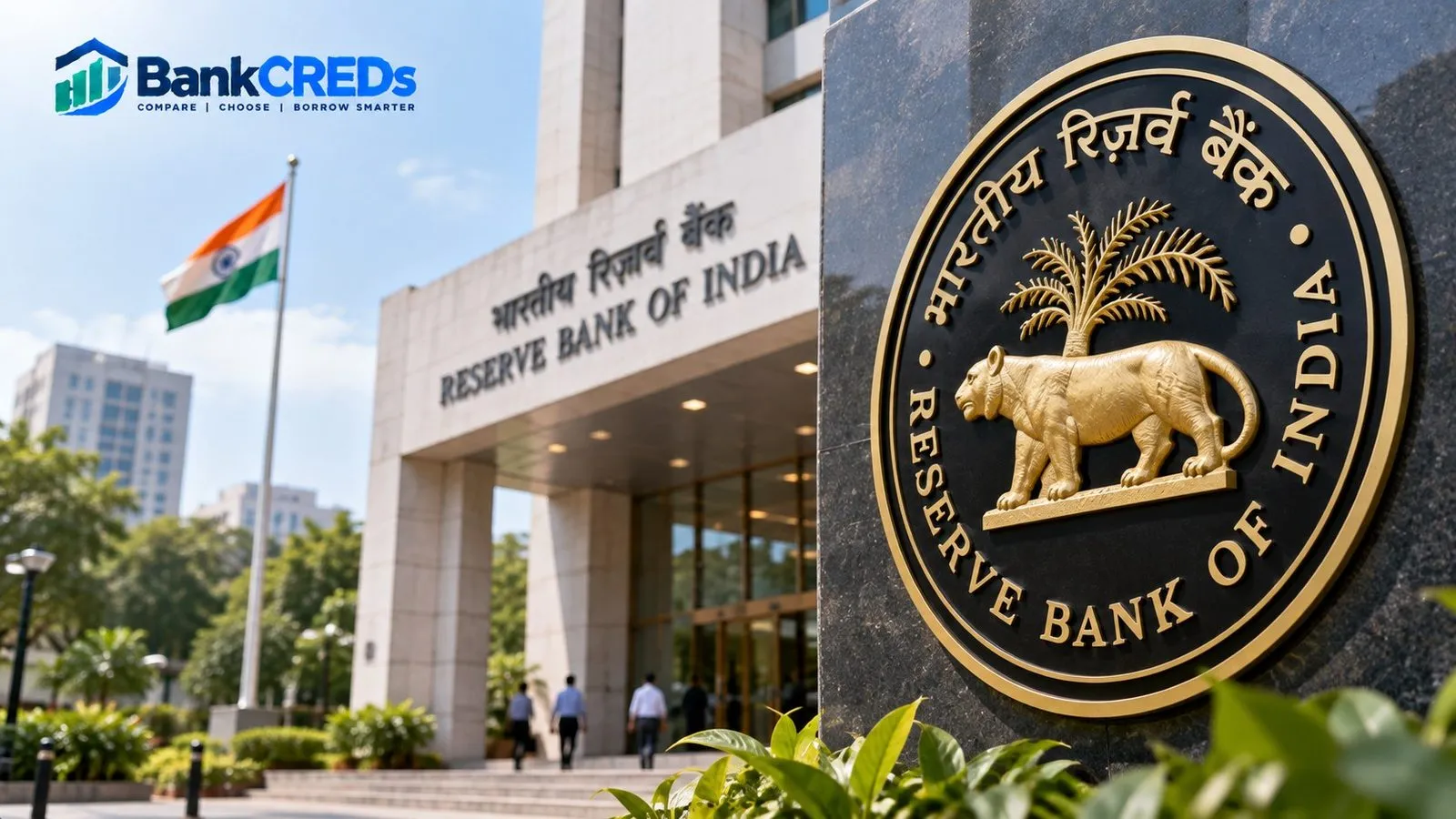
Markets are now pricing in roughly 125 basis points of interest rate hikes from the Reserve Bank of India over the next 12 months, according to reporting by bfsi.economictimes.indiatimes.com. For anyone repaying a floating-rate home, personal, or instant loan, that shift in expectations matters now — before it ever shows up as a higher EMI debit.
A basis point is one-hundredth of a percentage point, so 125 bps adds up to a full 1.25 percentage point rise in the benchmark repo rate if this pricing plays out. Most retail loans today are linked to external benchmarks tied to the repo rate, so a move of this size would reach borrowers within a single reset cycle — usually three months from an actual RBI decision.
It's worth being precise about what "markets pricing in" means: it reflects what bond and money-market traders currently expect based on futures and swap pricing, not a decision the RBI's Monetary Policy Committee (MPC) has taken or even scheduled. Actual outcomes at MPC meetings frequently land smaller than, larger than, or on a different timeline from what the market anticipated months in advance.
Key takeaways
- Markets are currently pricing roughly 125 bps of cumulative RBI rate hikes over the next 12 months, per bfsi.economictimes.indiatimes.com.
- This is a market expectation built from bond and derivative pricing — not an RBI announcement, and the MPC's real decisions could differ significantly.
- Floating-rate borrowers on EBLR-linked home, personal and instant loans would see EMI or tenure increases if the full move materialises, usually within three months of an actual repo rate change.
- Fixed-rate loans and loans that are mostly paid off are largely insulated from this particular shift.
- Savers holding fixed deposits, and investors in short-duration debt funds, stand to gain if deposit rates rise alongside a hiking cycle.
- The sensible response right now is to run the numbers on your own loan, not to react to a headline about market expectations.
How an RBI rate hike actually reaches your EMI
The RBI's repo rate is the rate at which it lends short-term funds to banks. Since October 2019, most new retail floating-rate loans — home, personal, vehicle, and many instant loan products — have been priced off an External Benchmark Lending Rate (EBLR), usually the repo rate itself plus a bank-specific spread. Banks are required to reset EBLR-linked loans at least once every three months to reflect the latest benchmark level.
That means when the RBI moves the repo rate, the change doesn't hit every borrower on day one — it lands on your next reset date, which depends on when your loan was disbursed. A hike announced in one month could take up to three months to show up in your EMI or tenure, depending on your bank's reset calendar.
Older loans still on the MCLR (Marginal Cost of Funds based Lending Rate) system reset on a similar quarterly-to-annual cycle but respond more slowly and less predictably to repo changes, since MCLR also reflects a bank's own cost of deposits. If you're unsure which regime your loan sits in, check your latest loan statement or ask your lender — it determines how quickly a rate hike would actually reach you.
What 125 bps of hikes could mean for borrowers
If the market's pricing is even directionally right, borrowers should plan for a gradual, staged increase rather than one large jump. RBI hiking cycles have historically moved in 25 or 50 bps steps across multiple meetings, not in a single move.
| Scenario | Cumulative hike | Approx. repo rate change | Typical borrower impact |
|---|---|---|---|
| Partial pricing plays out | 25–50 bps | Small uptick | EMI rises modestly or tenure extends by a few months |
| Market pricing fully plays out | 125 bps | Full 1.25 percentage point rise | Meaningful EMI increase or multi-year tenure extension on long loans |
| Market pricing overshoots | 0 bps (no hike, or a cut) | No change or a decrease | No impact, or EMI/tenure relief |
The table above is illustrative, built on standard EBLR mechanics — not a forecast. Market pricing is a probability-weighted average across many outcomes, and the actual path is very unlikely to be a single clean 125 bps move.
Borrowers should also note that most banks default to extending loan tenure rather than raising the EMI amount when rates rise, unless the loan is already near its maximum permissible tenure — in which case the EMI itself goes up. Check which convention your lender applies; it changes how a rate hike actually shows up in your monthly budget.
Worked example: a ₹40 lakh, 20-year home loan
To make this concrete, consider a ₹40 lakh home loan on a 20-year tenure at a starting floating rate of 9%. Using standard EMI arithmetic (illustrative, not lender-specific figures):
| Rate | Approx. EMI (₹) | Approx. total interest over 20 years (₹) |
|---|---|---|
| 9.00% (current) | ~35,990 | ~46.4 lakh |
| 9.625% (+62.5 bps, midway) | ~37,660 | ~50.4 lakh |
| 10.25% (+125 bps, full move) | ~39,370 | ~54.5 lakh |
A full 125 bps rise adds roughly ₹3,400 to the monthly EMI on a loan this size, and around ₹8 lakh in additional interest paid over the full tenure if the bank keeps tenure fixed and raises the EMI instead. If your bank instead extends tenure to hold the EMI steady, the same rate rise could add three to five years to a 20-year loan, depending on how close it already is to the maximum allowed tenure. You can run your own loan's numbers through an EMI calculator rather than relying on these illustrative figures.
Who is affected — and who genuinely isn't
Pointers on exposure:
- Most affected: Borrowers with large floating-rate home loans taken in the last 2-3 years, where the outstanding principal is still high and a rate change compounds over a long remaining tenure.
- Moderately affected: Personal and instant loan borrowers — these are shorter tenure, so a rate rise affects EMI more than tenure, but the total rupee impact is smaller since loan amounts are typically lower.
- Minimally affected: Anyone within the last 2-3 years of their loan tenure, since the outstanding principal exposed to a new rate is already small.
- Not affected: Borrowers on genuinely fixed-rate loans (common for some personal and consumer durable loans), and anyone who has already closed or substantially prepaid their loan.
- Potential beneficiaries: Savers and senior citizens holding fixed deposits, since banks typically raise deposit rates alongside — sometimes ahead of — a lending rate hiking cycle.
What savers should watch alongside borrowers
A rate-hike environment isn't only a borrower story. Banks facing a rising-rate environment usually compete for deposits by raising fixed deposit rates, and short-duration debt mutual funds tend to reprice faster than long-duration ones. If you hold both a loan and savings, the two effects can partly offset each other at a household level — higher EMI outflow, but potentially higher interest income on deposits.
Check your bank's current interest rate tables periodically rather than assuming they're static — FD rates typically move within weeks of a change in rate expectations, even before the RBI acts, since banks reprice ahead of anticipated moves.
What to do now: a practical checklist
- Identify whether your loan is on EBLR or MCLR, and find your next reset date on your latest statement.
- Recalculate your EMI at a 0.5% and a 1.25% higher rate using an EMI calculator so you know your worst-case monthly outflow before it happens.
- Check whether your bank extends tenure or raises EMI by default when rates rise, and confirm you're not already near the maximum tenure cap.
- If you're shopping for a new home loan or personal loan right now, compare lenders on spread-over-repo, not just the headline rate, since the spread is what stays fixed through the loan's life.
- Build a small EMI buffer into your monthly budget now rather than after a reset notice arrives.
- Avoid making large, irreversible financial decisions — like a big prepayment that drains your emergency fund — based purely on a market-pricing headline.
Common mistakes to avoid
A few things borrowers get wrong when rate-hike expectations hit the news:
- Treating a market-pricing estimate as a confirmed RBI decision — it isn't, and MPC outcomes often diverge from months-ahead pricing.
- Panic-prepaying a loan using emergency savings, which can leave a household without a buffer if income is disrupted.
- Assuming every loan resets immediately — EBLR loans reset quarterly at most, and MCLR loans can lag further.
- Ignoring the tenure-versus-EMI choice their bank makes by default, and being surprised later by which one changed.
- Not shopping around: a lender's spread over the benchmark, fixed at disbursal, matters as much as where the benchmark itself goes.
Frequently asked questions
What does "125 bps" mean in simple terms?
A basis point is one-hundredth of a percentage point, so 125 basis points equals 1.25 percentage points. If the repo rate today were, hypothetically, 6.5%, a full 125 bps hike would take it to 7.75%.
Will my EMI go up immediately if the RBI raises rates?
No. If your loan is linked to an external benchmark, your bank is required to reset the rate at least once every three months, not instantly. Older MCLR-linked loans can take even longer to reflect a change, since MCLR depends on the bank's own cost of funds too.
Should I prepay my loan now because of this news?
Not based on this headline alone. Market pricing reflects an expectation, not a certainty, and prepaying with funds you may need for emergencies can leave you worse off than a modest EMI increase would. Model the worst case with an EMI calculator first.
Does a rate hike benefit anyone?
Yes — savers. Fixed deposit rates and short-duration debt fund yields typically rise in a hiking environment, which benefits retirees and conservative investors even as it raises costs for borrowers.
Where can I track whether this actually happens?
Track official RBI Monetary Policy Committee statements directly rather than relying on market-pricing headlines alone, since MPC decisions are what actually change your loan's benchmark rate. BankCreds' news section also tracks rate-related developments as they're reported.
BankCreds analysis
The headline number — 125 bps — sounds dramatic, but it's a probability-weighted market average, and averages smooth over a lot of uncertainty. Markets have priced in large rate moves before that didn't fully materialise; treat this as one input into planning, not a forecast to act on today.
Where this actually bites is in the mismatch between how fast rates can rise and how slowly household budgets adjust. Take a household with a ₹40 lakh home loan and a ₹5 lakh personal loan running in parallel — a combined worst case of 125 bps across both isn't just the ~₹3,400 EMI increase on the home loan calculated above; it stacks with a smaller but faster-hitting increase on the personal loan, since personal loans carry shorter tenures and less room to absorb a hike through tenure extension. For that household, the personal loan is actually the more urgent one to stress-test, not the home loan, even though the home loan is larger in absolute rupee terms.
What this doesn't mean
It doesn't mean the RBI has decided anything, and it doesn't mean every borrower should rush to fix their rate or refinance this week. Fixed-rate options in India typically carry a meaningful premium over floating rates precisely because lenders price in this kind of uncertainty — locking in now, based on a market-pricing headline, can mean paying that premium for years even if the hikes only partially materialise.
The more useful reaction is asymmetric: the cost of running the arithmetic on your own loan is near zero, while the cost of an unnecessary prepayment, a rushed refinance, or a fixed-rate switch is real and hard to reverse. Households carrying multiple floating loans — a home loan plus a personal or instant loan — have more at stake per basis point than single-loan households, simply because the resets compound across accounts on different cycles. If nothing else changes this week, checking your reset dates and running a 1.25% stress test costs nothing and tells you exactly where you stand.
This section is BankCreds' own assessment of what the development means for Indian borrowers and savers. It is independent commentary, not part of the source reporting above.
Sources & references
- bfsi.economictimes.indiatimes.com — originating report https://bfsi.economictimes.indiatimes.com/articles/markets-pricing-125-bps-rbi-rate-hikes-over-next-12-months/134553387
- Reserve Bank of India — Official source for RBI Monetary Policy Committee decisions and repo rate announcements https://www.rbi.org.in/
- RBI Master Directions — Governs external benchmark lending rate (EBLR) reset frequency for retail floating-rate loans https://www.rbi.org.in/Scripts/BS_ViewMasDirections.aspx
Source links are shown as plain text, not clickable links. Copy a URL into your browser to read the original report.
Editorial note & disclaimer
How this was reported. The development above is attributed to the source or sources listed. BankCreds does not independently verify a third party's reporting; where a figure or a regulatory position is stated as fact, it is either attributed or drawn from the regulator's own published material. Everything under "BankCreds analysis" is our own assessment.
Rates and figures. Interest rates, per-gram values and premium bands quoted here are indicative, move daily, and differ by borrower profile, city and lender policy. Confirm the final number with the institution before you act on it — the sanction letter or policy schedule governs, not a news report.
Not financial advice. This article is general information for an Indian audience. It is not investment, tax, credit or insurance advice, takes no account of your circumstances, and BankCreds is not a lender, broker, distributor or advisor. Consider speaking to a SEBI-registered investment adviser or a qualified professional before acting.
Editorial policy · Fact-checking policy · Corrections policy · Our authors · About BankCreds · Contact us
Spotted an error? Corrections are published, not quietly edited — write to us via the contact page and see our corrections policy.